










But destination authority must reach the moments where travelers decide.
I have watched travel distribution move through several major eras.
I started in hospitality when travel expertise was still deeply human. Travel agents, hotel teams, and destination experts helped people make decisions through personal knowledge and direct relationships. Then came the OTA era, when scale, inventory, and convenience changed how travelers researched and booked. That era brought incredible efficiency, but it also introduced real tension for lodging suppliers and destinations around margins, control, attribution, and guest relationships.
We are now entering another shift whose full scale and impact are only just beginning to unfold.
Travel discovery is clearly moving into an AI-driven world. Travelers are increasingly asking conversational tools where to go, what to do, where to stay, and how to build the right trip. Search is becoming less about blue links, where DMOs have historically performed strongly, and more about synthesized answers. Planning is becoming less about manually visiting dozens of websites and more about asking an intelligent system to evaluate options on a traveler’s behalf.
It would be easy to assume this makes Destination Marketing Organizations less relevant. I believe the opposite is true.
In an AI-driven travel world, DMOs matter more, not less.
That is not because DMOs need to become something entirely different. It is because they already hold something AI systems increasingly need: trusted, human-generated, locally grounded knowledge of place.
DMOs produce destination content that is contextual, editorial, and rooted in real understanding of a place. It is not purely transactional, purely algorithmic, or simply scraped from inventory feeds. And increasingly, DMOs are working to structure that information in ways that make it more usable in a machine-readable world.
That combination—local authority, human perspective, and growing structural readiness—positions DMOs extremely well for the AI era.
But that strength is not evenly distributed across the traveler journey.
While DMOs are well positioned to influence where travelers go and what they do, that authority does not yet consistently extend into one of the most consequential and commercially important decisions in the trip-planning process.
And that category is lodging.
The Kind of Authority AI Needs
AI systems are only as useful as the information they can understand and trust.
When a traveler asks, “Where should I go for a long weekend with great food, walkable neighborhoods, and access to live music?” the answer requires more than a list of attractions or available rooms. It requires an understanding of place.
That is where DMO authority is different.
A DMO understands the destination as a living ecosystem. It understands neighborhoods, seasons, events, visitor patterns, cultural context, local businesses, and community priorities. It knows that two hotels a mile apart can create very different visitor experiences. It knows which districts come alive during a festival weekend, which areas are better for families, which event venues change lodging demand, and which local businesses help define the character of a trip.
That kind of knowledge is difficult for generic platforms to manufacture at scale. It is also part of what led me to start Ripe. I saw firsthand how OTAs failed to capture local nuance and the true character of a destination, especially when someone is traveling for a specific reason, such as an event.
That knowledge is increasingly valuable because AI systems do not simply retrieve information. Rather, they synthesize recommendations. And to do so, they need sources that can help them understand not just what exists, but what matters, what is current, what is trusted, and what is contextually relevant to a traveler’s intent.
This is why DMO-created content has a meaningful role in the AI era. It reflects human judgment, carries local nuance, and is shaped by an organization whose mission is tied to the destination itself, not only to the transaction.
But influence in an AI environment is not automatic.
AI systems will not rely on a DMO simply because it is the official destination organization. They will rely on the sources that provide the clearest, most useful, most structured, most actionable, and most context-rich answers to the traveler’s question.
A DMO may be highly authoritative about the destination overall, but that authority does not automatically transfer into every category where travelers make decisions.
Lodging is where that distinction becomes commercially important.
The Lodging Gap
As a former hotelier, I know how important the lodging decision is.
Where someone stays shapes almost everything about their trip: the neighborhood they experience, the restaurants they visit, the events they attend, whether they rent a car, and how they move through the destination.
Yet for many destinations, lodging is one of the thinnest parts of the DMO’s digital presence.
This is understandable. Historically, DMOs have not been built like lodging platforms. Their websites often focus on inspiration, events, itineraries, restaurants, attractions, and broad destination storytelling. Lodging may exist as a directory, partner listing, or basic booking widget, but it is often not deeply connected to the destination’s local expertise.
That creates a meaningful gap: a DMO may have deep authority about the destination, but much thinner authority around where travelers should stay inside that destination.
That matters because AI systems will evaluate which source has the most useful, structured, contextual, and actionable information for the traveler’s question.
If the DMO has rich content about hiking, arts, restaurants, events, and neighborhoods, but lodging content is shallow or disconnected, then the DMO may influence the “why visit” part of the journey while being bypassed on the “where to stay” decision.
And the “where to stay” decision is where much of the economic value is captured for both the destination and lodging partners.
From Destination Authority to Lodging Intelligence
This is the next opportunity for DMOs.
It is not to become another OTA. That is not where the DMO advantage sits.
The opportunity is to extend destination authority into lodging intelligence by bringing trusted local knowledge closer to where travelers are making lodging decisions.
That means helping travelers understand lodging through the lens of the destination while still accounting for the practical realities that drive booking: availability, price, amenities, room type, location, and timing.
The goal is not to replace those basics with local context. It is to combine them, so a traveler is not just seeing what is available, but understanding what is available and why it fits their trip.
It means answering the kinds of questions generic platforms often struggle to answer well:
- Which hotels are best for a festival weekend?
- Which properties are walkable to the trailhead, beach, arena, or downtown district?
- Which part of town fits a family trip versus a couples’ getaway?
- Which lodging options are closest to the event start line?
- Which properties support the kind of experience the traveler is actually trying to have?
This is where DMOs have an advantage. They already understand the local context. They already know the neighborhoods, events, partners, and visitor patterns. The challenge is making this knowledge usable.
In the AI era, it is not enough for local expertise to live in a blog post, a PDF, a staff member’s head, or a static hotel listing. It has to be structured, connected, and available in formats that modern systems can understand.
That is the shift from lodging content to lodging intelligence.
Why Structure Matters
Local knowledge only creates AI influence if it can be understood.
A traveler may look at a beautiful destination website and intuitively understand the brand, photography, and story. An AI system needs something different: clear entities, relationships, context, reliable data, and for lodging, a connection to the real-time details that determine whether a recommendation is actually useful.
It needs to understand that a property is not just a hotel, but a hotel in a specific neighborhood, near a specific venue, relevant to a specific event, and suited to a specific traveler intent.
It needs to understand that phrases like “walkable to Main Street,” “official event hotel,” “near the race start,” “good for families,” or “best for a quiet midweek stay” are not just marketing language. They are meaningful pieces of context that can shape a lodging recommendation.
But it also needs to know whether that property is available, whether the price fits the traveler’s budget, and whether there is a clear path to book. Local context may make a recommendation better, but availability and pricing make it actionable.
This is why the next phase of destination lodging is not simply about adding more listings or writing longer descriptions. It is about making the DMO’s local knowledge structured, contextual, and connected enough to influence how AI systems evaluate where a traveler should stay.
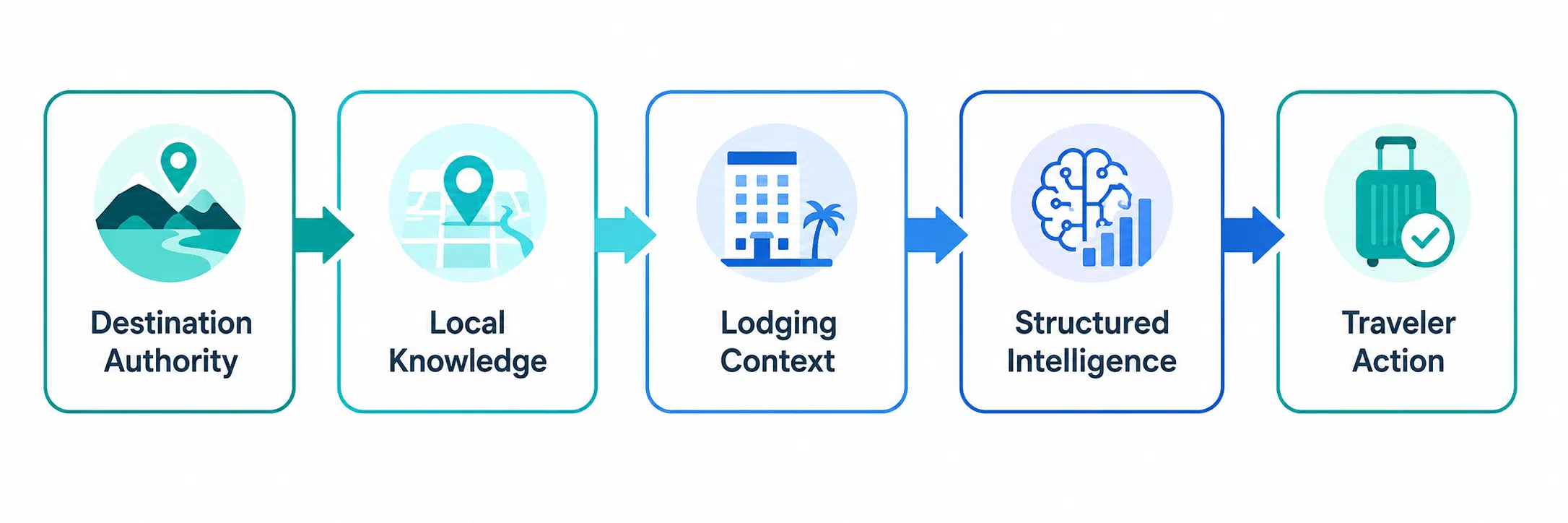
The path forward is a progression: destination authority becomes trusted local knowledge; local knowledge becomes lodging context; lodging context becomes structured intelligence; and structured intelligence becomes influence where and when a traveler is ready to act.
The Risk of Being Bypassed
If DMOs do not make this shift, the risk is not that travelers will stop caring about destinations.
The risk is that destination influence and lodging conversion become separated.
A traveler may still be inspired by DMO-created content. They may still learn about neighborhoods, events, restaurants, outdoor recreation, and local culture from the destination’s official channels. But when they ask an AI system where to stay, that system may turn to the sources with the most complete, structured, and transaction-ready lodging data.
Today, that often means OTAs, metasearch platforms, or other intermediaries.
Over time, that dynamic introduces a second-order risk that is often overlooked: attribution erosion back to lodging constituents.
Many DMOs are funded, directly or indirectly, by lodging partners. If the lodging decision increasingly happens through channels outside the DMO’s influence, the DMO risks becoming less central to the economic outcomes that justify its funding model. It may still shape destination demand, but lose visibility and perceived contribution at the point where lodging revenue is realized.
Hotels face a related challenge. If AI increasingly surfaces OTA-driven content, availability, and pricing as the default “answer layer,” hotels become even more dependent on those intermediaries for visibility. That is not just a margin issue. It is a structural dependency issue that increases acquisition costs, reduces direct booking share, and further distances hotels from first-party guest data and relationship ownership.
In that scenario, the DMO still contributes meaningful value to the traveler journey, but does not fully capture the influence, attribution, data, or economic return from the lodging decision—while its lodging constituents become more dependent on high-cost, third-party channels to reach the same traveler.
That is the strategic gap.
The DMO remains highly relevant to why people visit, but weaker at the moment traveler intent becomes economic action.
This is not a criticism of DMOs. It is an opportunity.
The authority is already there. The local knowledge is already there. The trusted voice is already there. The next step is extending that authority into lodging in a way that AI systems, travelers, hotels, event partners, and local stakeholders can actually use.
The Next Role of the DMO
The DMO’s role is evolving.
It is no longer enough to be only a destination publisher. It is no longer enough to drive awareness and hope that the value created by that awareness eventually benefits the local ecosystem.
The next role of the DMO is to become a trusted local hub that helps organize the visitor economy across content, partners, events, lodging, data, and distribution.
That does not mean the DMO has to build every piece of technology itself. Most should not.
But it does mean DMOs should be asking a more practical set of questions:
- Can we help a traveler answer a nuanced lodging question based on availability, budget, amenities, guest sentiment, trip purpose, and local context?
- Is our lodging content as strong, structured, and useful as our destination content?
- Are we helping travelers choose where to stay based on real local context—not just availability and price?
- Are we supporting hotels and event partners with better demand capture and more qualified intent?
- Are we keeping more visitor data and economic value connected to the destination ecosystem?
- Are we building infrastructure that works beyond our website—into the systems where travel decisions are increasingly being made?
These are not abstract technology questions. They are destination strategy questions. Because in an AI-driven travel world, the destinations that are best understood will be the destinations that are most often recommended.
And the lodging options that are best contextualized will be the lodging options most likely to be considered.
Keeping Value In-Market
This is the shift we are building around at Ripe.
We believe the future of destination lodging is not simply another booking widget or another directory. It is infrastructure that helps DMOs turn trusted local authority into lodging experiences that are discoverable, contextual, bookable, and aligned with the local economy.
That belief is rooted in a simple idea: What happens in-market should stay in-market.
The value created by destination marketing should not automatically leak away to platforms that do not represent the local community. The data generated by visitor demand should help the destination understand and serve its own travelers. The economic benefit of tourism should be more visible, more measurable, and more connected to the stakeholders who make the destination worth visiting.
AI does not change that principle. It makes it more important.
As travel discovery becomes more automated and more mediated by intelligent systems, DMOs have a chance to strengthen their role as the trusted source of local truth.
The more travel decisions move into AI-mediated environments, the more important it becomes that local destinations retain a direct role in shaping, measuring, and benefiting from those decisions.
Lodging is one of the most important places to start.
DMOs already matter. The next step is making sure their authority matters where the traveler is ready to act.
We’d love to give you a closer look at how an In-Market Travel Agency leverages DMO knowledge and authority to ensure lodging supply is AI-discoverable and transaction-ready. Book a demo, and our team will be in contact.